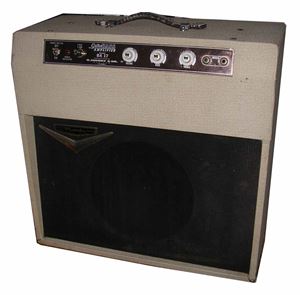

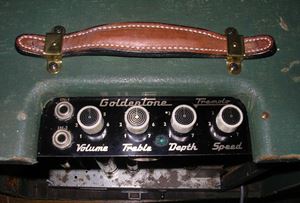
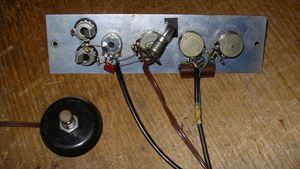
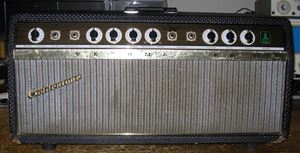
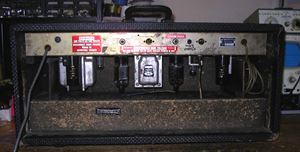
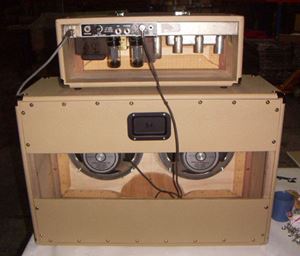
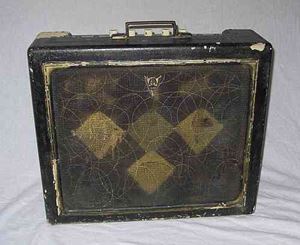
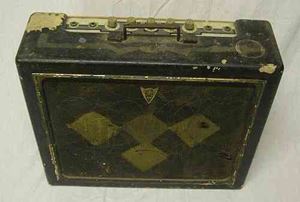
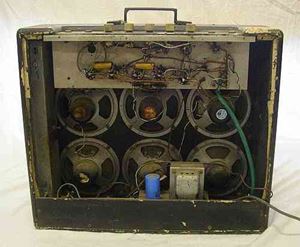
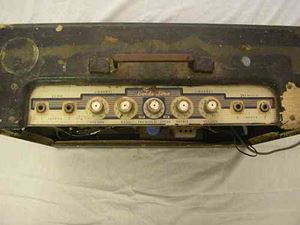
Here is another restoration project, also a Goldentone amplifier. This one I’ve called the Roadkill project, because the amp was found by the side of a road. It had been put out for a hard waste garbage collection, and was spotted by the current owner as he was driving past.
The amp is a Goldentone 8/50. The designation means 8 valves, 50 watts. The amp has six inputs, marked Instrument / Microphone. Two channels, each with Bass, Treble and Volume controls. Channel One also has a tremolo. All of the small signal valves were pentodes (two EF86 as the first stage for both channels, an EF86 for the power amp’s volt amp, and a 6AU6 for the trem oscillator). The phase splitter is a 12AX7 (long-tailed pair).
For a while I thought it may have been designed as a PA amp for a set of microphones, but why was there a tremolo? A bit of mystery, that one.
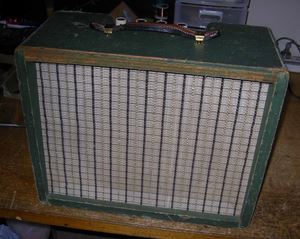
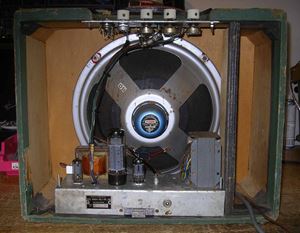
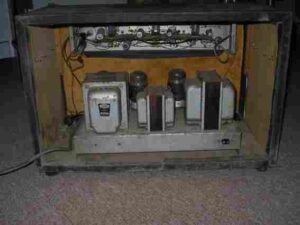 But there was a nice surprise when we turned the box around. The power amp is HUGE.
The amp had spent 20 years in the back of a shed. The original amp was an ultralinear design, using a pair of KT88 power valves, with a 5AR4 valve rectifier. The B+ was 550 volts, with a choke pi filter. These are the original valves, still with the GEC sticker on the bottles. Their measured emission is still 120% their original design spec!! This was one serious amp – I reckon its power output was nearer 60 watts than 50. The build label says Rose and Clark, Melbourne. I think the amp was probably built in the early 1960’s.
The amp had been used as a bass amp most of its life, but I discovered later that it probably started life as an amp for an electric piano – which explains the tremolo, and the big, clean hi-fi style power stage.
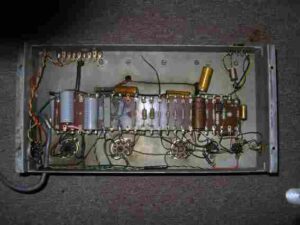
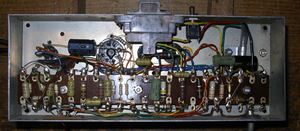
The power amp was cathode biased.
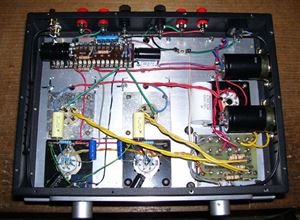
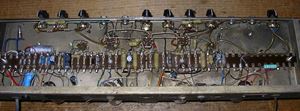
You can see the cathode resistors just to the right of the blue power capacitors. There was a lot of heat damage on the board, and one set of cathode resistors had been repaired at some stage – unfortunately, the replacements were rated too low, and had burnt out. I expect this is what retired the amp. Due to the age and condition of the electronics, the amp needed a complete rebuild.
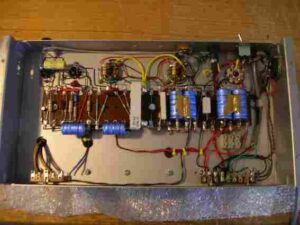 The old board was re-used. The chassis was sand-blasted and re-painted with a double pack automotive enamel.
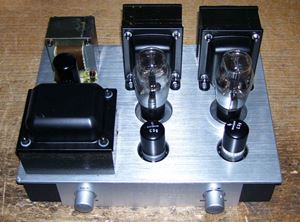
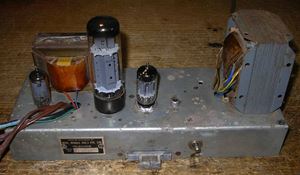
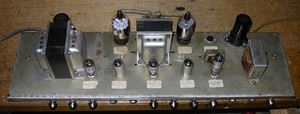
Here is the chassis, with the original KT88s in all their glory, and the original rectifier.
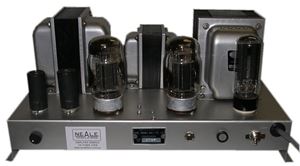 KT88 Power Amp. As can be expected from such huge transformers, the amp runs very cool.
This transformer set is already 45 years old, but there is no reason why they wouldn’t last for another 45 years. You can’t beat quality valve amps for a long life.
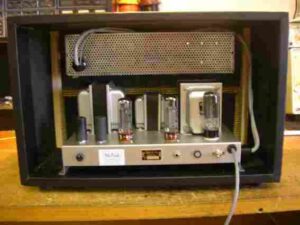 The pre-amp has been made safe with a new mesh cage.
The pre-amp is connected to the power amp with an umbilical cable that takes the pre-amp B+, the heaters, a standby switch loop, and the signal input cable. A master volume has been fitted to the power amp chassis.
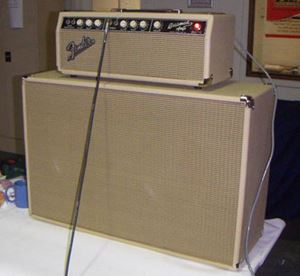
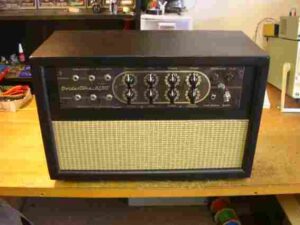 The roadkill amp box has been re-covered with polished black vinyl. These pictures don’t show the face plate in all its glory unfortunately – all of the graphics on the panel are silver on a black background, and the panel has now been covered with a lacquer finish.
My thanks to Mark Huxtable for finding this great old amp by the side of the road, and Bob Rundle for giving me the clue to its original purpose. And of course, many, many thanks to the great amp engineer who designed this thing in the first place – by selecting top quality transformers the amp is assured another lifetime or two.
By the way, this amp was offered on E-bay in the condition shown in the first picture – the original owner got no offers, so carted it out to the side of the road, just as Mark drove past. Which just goes to show, what is one man’s garbage is another man’s gold!!
This project converted a Marshall JCM900 series amp into a Fender style Vibro-King amp, by gutting the entire amp, keeping only the chassis, transformers and tube sockets.
The amp gained a GZ34 valve rectifier, a 6V6 tube to drive an Accutronics long tank, and two more 12AX7s. The power tubes were changed to Soviet military 6L6GTs. Two small heater transformers were added, one for the rectifier heater (5 volts), and one for the two extra signal tubes. Changing from EL34s to 6L6s freed up a bit of heater capacity in the existing power transformer, which was used for the 6V6.
The Vibro-King architecture was used, which has a reverb main channel (with Dwell, Tone and Mix and Channel Gain), followed by the Fender Bassman style tone stack (Treble ,Middle, Bass, and Volume). A tremolo was also added, with Speed and Intensity, and power stage injection (via the bias circuitry).
Parts of the orginal Marshall board were kept – the power end with fuses, and the original Line In/Line Out circuitry was maintained.
In keeping with the Soviet military theme, all of the new electronics were wired on 18-tag turrets, sourced from the Ukraine.
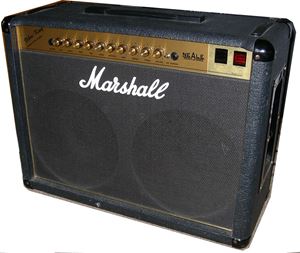
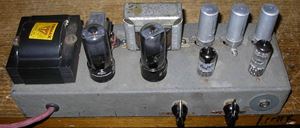
Converted amp, with new front panel fitted. Not quite the same colour, but I didn’t want to rework the power and standby switches. I suppose the original bit on the right could be called the “legacy panel”.
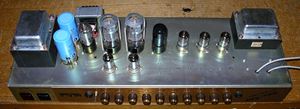
Here is the chassis, with the rectifier heater transformer just to the right of the existing blue power caps. The chassis was designed for a quad of output tubes, which was handy, because one hole could be used for the GZ34 rectifier (next to the power caps) and another hole used for the 6V6 reverb driver tube (the black one in the middle). The two new 12AX7s are in front of the 6L6GT power tubes.
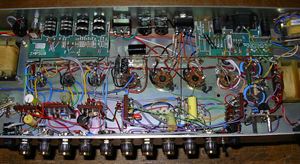
Here’s a guts shot, showing the use of the original Marshall board for the line in/line out circuitry (left rear) and the power input and fuse section (right rear).
The 18-way turrets make re-wiring circuitry very easy, and keeps signal paths very short.
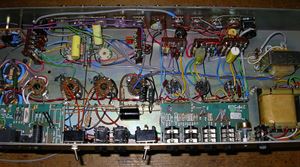
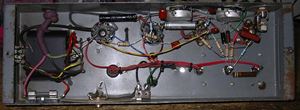
Here’s the reverse pic of the circuitry, which shows the turrets and the control wiring.
The new bias control board is right up the top left of this pic – much easier to access for setting bias.